
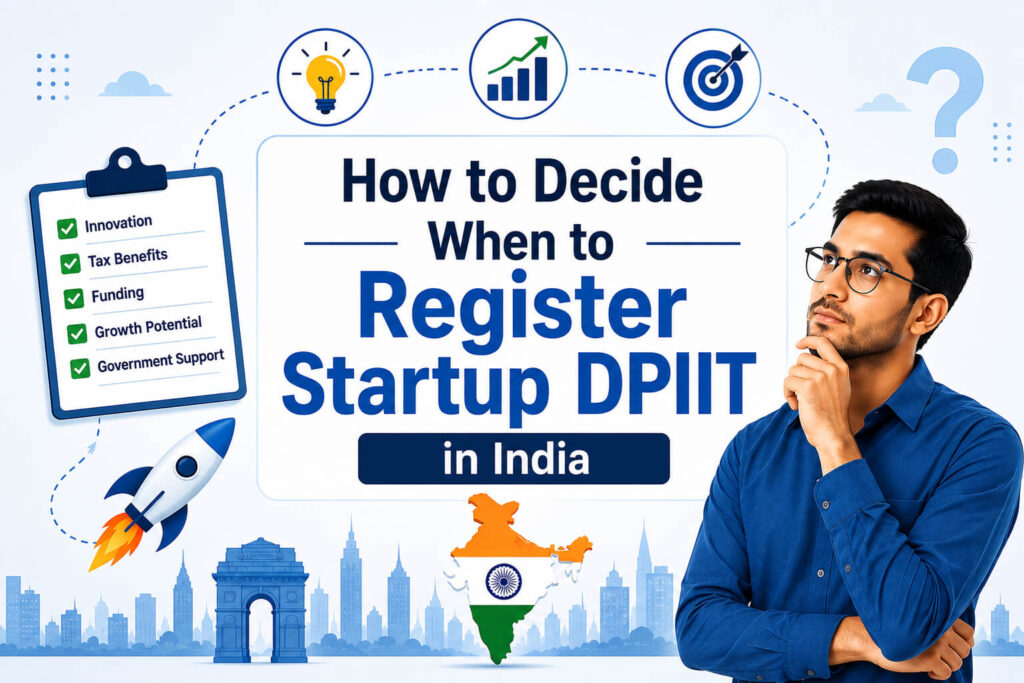
However, you now face a key decision: should you Register Startup DPIIT or wait? OurCASaab’s guidance helps you decide clearly. Additionally, registering too early may prevent you from fully leveraging the benefits. Wait too long, and you could miss out on funding, tax advantages, or credibility when it matters most. This guide helps you decide exactly when to Register Startup DPIIT.
Additionally, it explains signals to look for and how the timing aligns with growth. If you plan to Apply for Startup India Recognition today, this article clarifies the steps.
What Does It Mean to Register Startup DPIIT?
Before deciding when, it’s important to understand what DPIIT registration actually does.
In addition, the Department for Promotion of Industry and Internal Trade (DPIIT) offers official recognition under the Startup India initiative. Once approved, your business gains access to:
- Additionally, tax exemptions are available (subject to eligibility).
- Moreover, easier compliance processes help streamline operations.
- Furthermore, access to government tenders.
- Better credibility with investors and partners
If you’re already exploring Startup Registration In India, DPIIT recognition is the next strategic step not just a formality.
Why Timing Matters More Than You Think
Many founders assume they should Apply for Startup India Recognition immediately after incorporation. That’s not always the best move.
Timing affects:
- Your eligibility for tax benefits
- Your ability to demonstrate innovation
- Investor perception during fundraising
Registering at the right stage ensures you don’t just qualify but actually benefit.
5 Clear Signs It’s Time to Register Startup DPIIT
1. You Have a Defined Business Model
If your idea is still evolving daily, it’s too early.
DPIIT recognition requires you to clearly explain:
- What problem you’re solving
- How your product/service works
- What makes it innovative
Example:
A founder with just a concept note may struggle to justify innovation. But once they have a working prototype or defined service offering, their application becomes stronger.
2. You’re Preparing for Funding or Investor Conversations
Investors often look for signals of credibility and DPIIT recognition is one of them.
If you’re about to:
- Pitch to angel investors
- Apply for startup grants
- Join an incubator
it’s a good time to Apply for Startup India Recognition Today.
Mini-scenario:
Two startups pitch the same idea. One is DPIIT-recognized, the other isn’t. The recognized startup often appears more structured and compliant.
3. You Want to Access Tax Benefits (And Can Qualify)
One of the biggest advantages is tax exemption under Section 80-IAC but it comes with conditions.
You should consider registration if:
- Your startup is within the eligible age limit
- You expect profits in the near future
- You meet innovation and scalability criteria
Important:
Tax benefits aren’t automatic. DPIIT recognition is the first step, not the final approval.
4. Your Business Is Operational (Not Just an Idea)
DPIIT prefers startups that are already doing something selling, testing, or scaling.
Good indicators include:
- You have paying customers
- You’ve launched a beta product
- You’ve validated demand
Example:
A D2C brand with consistent monthly orders is in a much better position to justify registration than someone still researching suppliers.
5. You Need Credibility for Partnerships or Tenders
Government tenders and corporate partnerships often require a level of trust.
DPIIT recognition helps you:
- Qualify for startup-specific tenders
- Build trust with vendors and clients
- Stand out in competitive markets
If credibility is becoming a bottleneck, it’s time to act.
When You Should Wait Before Registering
Not every business is ready and that’s okay.
Hold off if:
- Your idea is still unstructured
- You haven’t validated your market
- You can’t clearly explain your innovation
- You haven’t completed basic business setup
Instead, focus first on:
- Completing Private Limited Company Registration In India or LLP Registration in India
- Building a minimum viable product (MVP)
- Testing your market
Step-by-Step: How to Register Startup DPIIT
Once you’re ready, the process is straightforward but requires accuracy.
Key steps:
- Incorporate your business (Pvt Ltd, LLP, or Partnership)
- Prepare a clear business description
- Highlight innovation and scalability
- Submit your application on the Startup India portal
- Wait for DPIIT approval
Common Mistakes Founders Make
Even strong startups get rejected due to avoidable mistakes.
Watch out for:
- Vague or generic business descriptions
- No clear innovation angle
- Copy-paste applications
- Applying too early without traction
Example:
A consulting firm applying without a unique model may be rejected, while a tech-enabled consulting platform with automation features may qualify.
How DPIIT Registration Aligns With Your Growth
Think of DPIIT recognition as a strategic milestone, not a checkbox.
It fits best when:
- You’re transitioning from idea to execution
- You’re preparing to scale
- You’re entering funding or expansion stages
Used correctly, it strengthens your business positioning not just your paperwork.
Practical Takeaway
Don’t rush to register just because it’s available, but don’t delay once your business shows real traction.
The right time to register startup DPIIT is when you can clearly demonstrate value, innovation, and growth potential. Ideally with the support of Online CA Services in India. This helps ensure compliance and strategic readiness.
If you’re at that stage and ready to move forward, take the next step confidently and Apply for Startup India Recognition Today with proper guidance:
👉Ready to launch your startup the right way? Get expert assistance today.
📞 +91-99114 91551 | 📧 info@ourcasaab.com
