
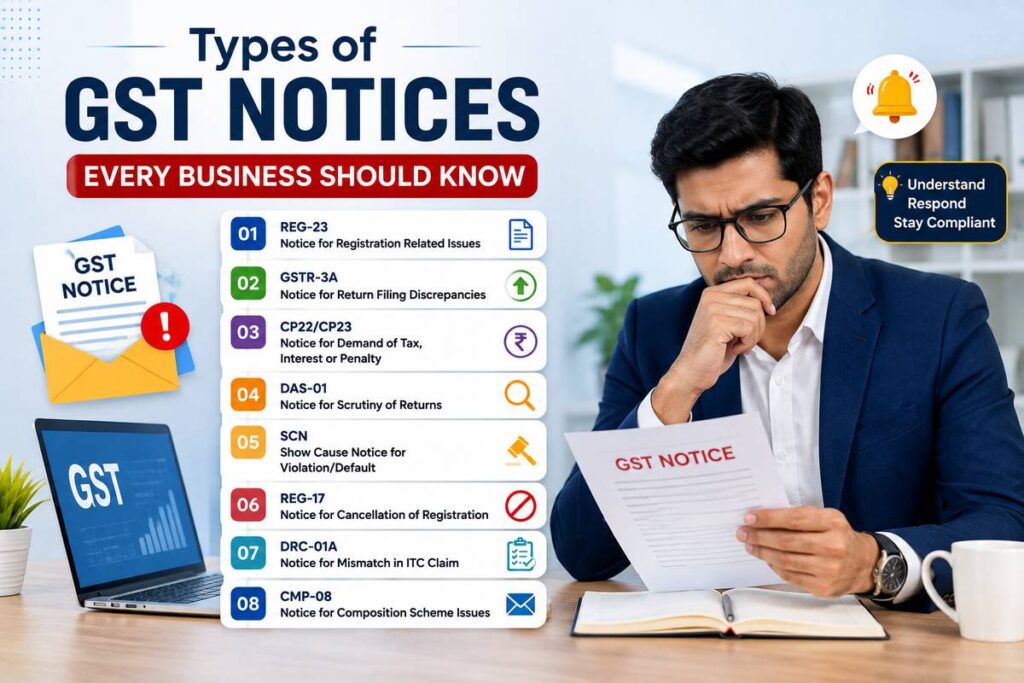
You’re going about your business filing returns, managing invoices when suddenly a notice from the GST department lands in your inbox. It’s formal, technical, and often intimidating. Ignoring it isn’t an option, but understanding it isn’t always easy either. OurCASaab helps businesses navigate such GST-related requirements with practical guidance and professional support.
This guide breaks down the most common GST Notices you may encounter and what they actually mean for your business. If you’re handling GST filing or considering Online GST Registration in Delhi, knowing these notices can help you stay compliant and avoid unnecessary penalties.
GST notices are not always a sign of wrongdoing. In many cases, they’re simply requests for clarification or additional information. However, failing to respond correctly or on time can escalate into penalties, audits, or legal complications.
Whether you’ve completed GST Registration in India, run a Private Limited Company Registration In India, or opted for LLP Registration in India, these notices apply across all business structures.
1. Notice for Non-Filing of GST Returns (GSTR-3A)
This is one of the most common GST Notices issued to businesses.
When do you receive it?
If you fail to file your GST returns (GSTR-1, GSTR-3B, or GSTR-4), the tax department sends a GSTR-3A notice reminding you to comply.
What does it mean?
It’s essentially a warning. The department is notifying you that your returns are overdue and need immediate attention.
What should you do?
- File the pending returns as soon as possible
- Pay any applicable late fees and interest
- Ensure future compliance to avoid repeated notices
Example:
A small retailer misses filing GSTR-3B for two months. They receive a GSTR-3A notice prompting immediate filing. Ignoring it could lead to further action like assessment notices.
2. Notice for Mismatch in GST Returns (GSTR-2A/2B vs GSTR-3B)
Errors in reporting are more common than you might think.
When do you receive it?
When there’s a discrepancy between your input tax credit (ITC) claims and the data available in GSTR-2A or GSTR-2B.
What does it mean?
The department is flagging inconsistencies in your records Online CA Services in India often related to ITC claims.
What should you do?
- Reconcile your purchase records with GSTR-2A/2B
- Identify missing or incorrect invoices
- Amend returns if necessary
Example:
A business claims $5,000 in ITC, but only $4,200 appears in GSTR-2B. The mismatch triggers a notice requiring explanation.
3. Show Cause Notice (SCN)
This is a more serious type of gst notice.
When do you receive it?
When the tax department believes there has been non-compliance, underpayment, or wrongful ITC claims.
What does it mean?
You are required to justify why action (like penalties or tax recovery) should not be taken against you.
What should you do?
- Carefully review the allegations
- Prepare supporting documents
- Respond within the stipulated timeline
Example:
If a company incorrectly claims ITC on ineligible expenses, it may receive an SCN asking for justification.
4. Assessment Notice (Best Judgment Assessment – ASMT-10)
Sometimes, the department estimates your tax liability.
When do you receive it?
If you fail to file returns or provide adequate information, the officer may assess your tax liability based on available data.
What does it mean?
The department is making a “best judgment” assessment of your tax dues.
What should you do?
- File pending returns immediately
- Provide accurate financial data
- Request reassessment if necessary
Example:
A business that hasn’t filed returns for multiple periods may receive an estimated tax demand based on past filings or industry averages.
5. Notice for Audit or Inspection
This is typically issued for deeper scrutiny.
When do you receive it?
If your business is selected for audit or inspection by GST authorities.
What does it mean?
Your records, returns, and compliance practices will be examined in detail.
What should you do?
- Maintain organized financial records
- Cooperate with authorities
- Seek professional assistance if needed
Example:
A mid-sized company with fluctuating turnover may be selected for audit to verify compliance and reporting accuracy.
How to Stay Prepared and Avoid GST Notices
While not all gst notices can be avoided, many can be prevented with consistent compliance.
Key practices:
- File returns on time, every time
- Reconcile accounts regularly
- Keep accurate and updated records
- Verify ITC claims before submission
- Stay updated on GST rules
If you’re just starting out or expanding your business, getting expert help during registration and compliance can save you significant trouble later. For businesses looking for GST Registration in India, you can explore professional support here:
When Should You Seek Professional Help?
Not every notice requires panic but some demand expertise.
Consider professional assistance if:
- You receive a Show Cause Notice
- There’s a significant tax demand
- You’re unsure how to respond
- Your business is under audit
Experts can help draft accurate responses, represent your case, and ensure compliance with GST laws.
Practical Takeaway
GST notices are part of running a compliant business, not something to fear, but something to understand. The faster and more accurately you respond, the smoother your operations remain. With Online CA Services in India, businesses can get professional support for managing GST compliance and related requirements.
Stay proactive, keep your records clean, and treat every notice as an opportunity to correct and strengthen your compliance process.
👉 Need GST Registration? Get expert assistance and simplify the process with OurCASaab. Start today!
📞 +91-99114 91551 | 📧 info@ourcasaab.com
