
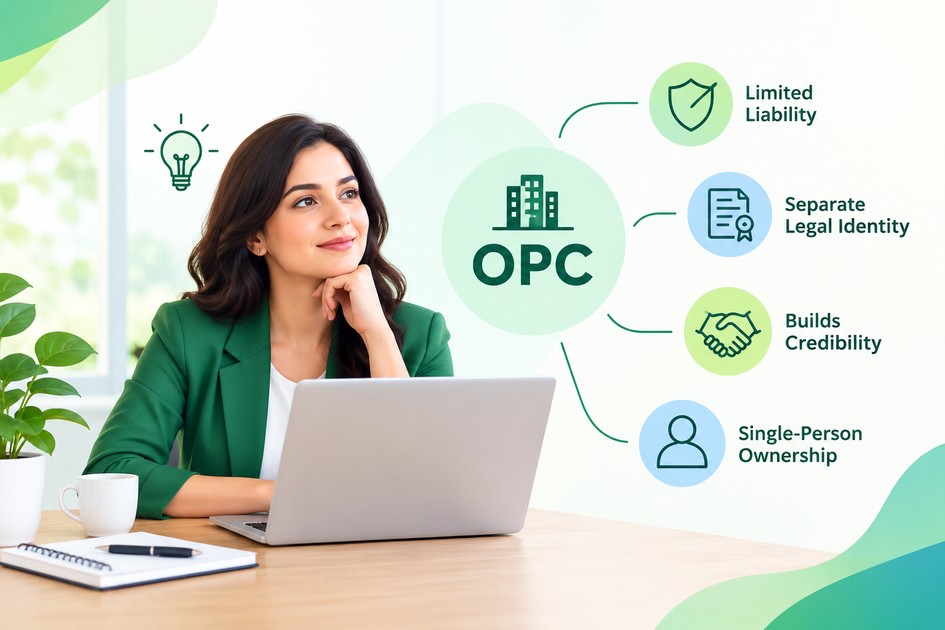
Running a business as a freelancer or solo entrepreneur gives you control, but it can also leave you personally exposed to business risks. If you want to build a professional business without bringing in another owner, One Person Company Registration in india (OPC) may be a suitable option. This guide explains how an OPC works, its key benefits, eligibility requirements, registration costs, and ongoing compliance obligations so you can decide whether it fits your business goals.
What Is a One Person Company (OPC)?
A One Person Company is a business structure under the Companies Act, 2013, that allows a single person to establish a company with a separate legal identity. Unlike a traditional partnership, an OPC can have one member while operating as a registered company.
For example, suppose you run a digital marketing agency independently. You manage clients, issue invoices, and pay business expenses yourself. Registering an OPC can help you separate the company’s legal identity from your personal identity and establish a more formal structure for business operations.
What’s in It for You? Key Business Benefits
Choosing an OPC is not just about registration. It is about creating a structure that supports your business while offering legal and operational advantages.
1. Limited Liability and Asset Protection
One of the main benefits of an OPC is limited liability. Generally, the member’s liability is limited to the amount unpaid on their shares, subject to applicable legal exceptions.
This distinction can be valuable if your business enters into contracts, purchases equipment, or takes on commercial obligations. However, limited liability is not absolute, and personal guarantees, fraud, or certain legal violations may still create personal liability.
2. A Separate Legal Identity
An OPC has a legal identity distinct from its member. This allows the company to own assets, enter into contracts, and conduct business in its own name.
A separate identity can also help when opening a business bank account, formalising client agreements, and maintaining company records.
3. Greater Business Credibility
Some clients, vendors, and corporate customers prefer working with registered entities because their ownership and compliance structure is formally documented.
For a freelancer planning to work with larger organisations, an OPC can provide a more structured business presence. It does not guarantee contracts or funding, but it may support your professional image.
4. Single-Person Ownership and Management
An OPC is designed for entrepreneurs who want to retain ownership without adding another shareholder. You can manage business decisions while complying with the legal requirements applicable to the company.
This structure may suit consultants, independent professionals, online business owners, and founders who want to formalise a business before expanding.
Read More :- Benefits of Outsourcing Accounting for Small Businesses
Who Is Eligible to Register an OPC?
Before starting the registration process, check whether you meet the applicable requirements.
Generally, the key conditions include:
- Eligible individual: The member must be a natural person who is an Indian citizen, whether resident in India or otherwise, subject to the applicable rules.
- One member: An OPC has only one member.
- Nominee: A nominee must be appointed as required under company law to provide for succession in specified circumstances.
- Permitted business: The proposed business must comply with the activities permitted for an OPC.
- Legal registration: The company must be incorporated with the Ministry of Corporate Affairs (MCA).
An OPC cannot simply be used as a substitute for every type of business structure. Review your eligibility and intended business activities before applying.
Documents Required for OPC Registration
The exact documentation depends on the applicant and registered office arrangements. Common requirements include:
- PAN card and identity proof of the proposed member.
- Address proof of the member.
- Registered office address proof.
- Recent utility bill for the registered office, where applicable.
- No-objection certificate from the property owner, where required.
- Identity and consent documents for the nominee.
- Digital Signature Certificate (DSC) and other incorporation declarations, as applicable.
The incorporation application is generally submitted electronically through the MCA system using the prescribed forms and procedures.
OPC Registration Cost and Fees
The total cost of One Person Company Registration depends on government filing charges, applicable stamp duty, digital signature requirements, and professional service fees.
Rather than relying on a fixed estimate, ask for a cost breakdown before beginning the process. Confirm what is included, such as document preparation, name approval, incorporation filing, and support with initial compliance requirements.
Read More :- What is an Online CA? Services, Benefits & How It Works
OPC vs Other Business Structures
An OPC is not automatically the best option for every entrepreneur. Compare it with other structures before making a decision.
- Sole proprietorship: Usually simpler to establish, but it does not provide the same separate company identity or limited-liability structure.
- Private limited company: Often more suitable when multiple shareholders, equity investment, or a broader ownership structure is planned.
- Limited Liability Partnership (LLP): May suit businesses that prefer a partnership-based management structure with limited liability, subject to applicable law.
If you expect to bring in co-founders or investors soon, consider whether Private Limited Company Registration in India would better support your long-term plans.
What About Taxation and Annual Compliance?
An OPC must meet applicable tax and corporate compliance requirements. These may include maintaining books of account, filing income tax returns, preparing financial statements, and submitting annual returns and other prescribed documents to the MCA.
Although an OPC has one member, it is not free from compliance obligations. Budget for accounting, tax filing, and annual maintenance from the beginning. Professional Online CA Services in India can help business owners manage these responsibilities and keep their records organised.
An OPC may also be eligible for conversion into another company structure when business needs change, subject to the applicable Companies Act provisions and rules
Is an OPC the Right Choice for You?
If you operate independently, want a formal company structure, and value limited liability, an OPC may be worth considering. However, your expected growth, compliance budget, funding plans, and ownership requirements should guide the final decision.
Before proceeding, review the One Person Company Registration in India process and understand the applicable requirements.
OurCASaab helps entrepreneurs and business owners navigate company registration and compliance requirements. Get professional guidance to assess your eligibility, understand the registration process, and choose a structure that supports your business plans.
Phone: +91-99114 91551 | Email: info@ourcasaab.com
