
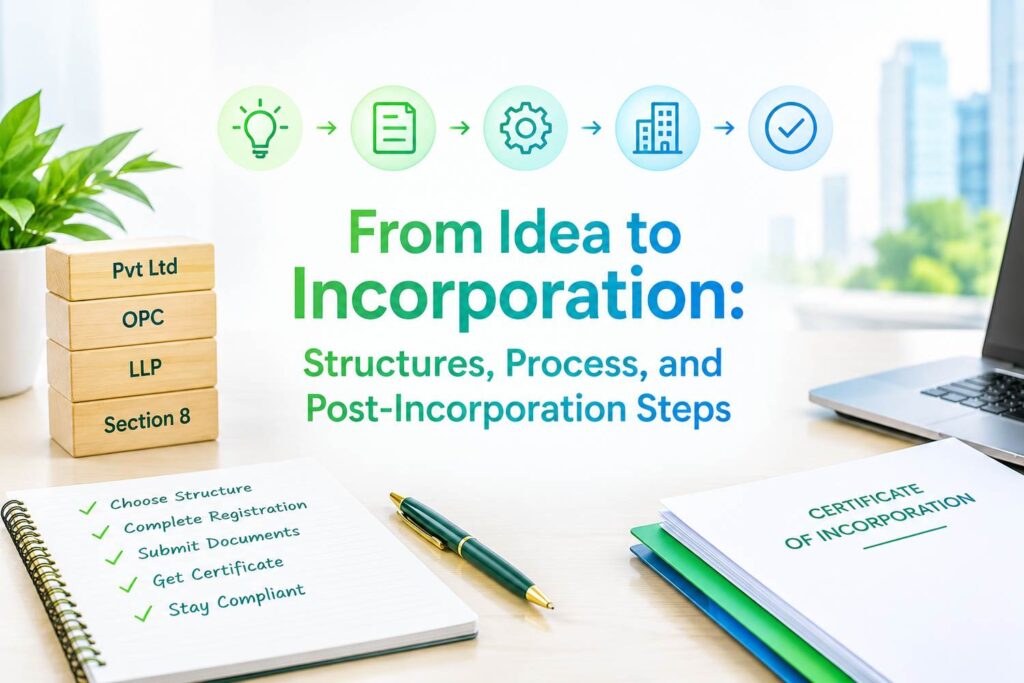
Starting a business is one of the most exciting things you’ll ever do. But somewhere between the spark of an idea and your first invoice sits a maze of paperwork, filings, and compliance rules that can quietly drain your momentum — or worse, land you in legal trouble. OurCASaab helps simplify this journey by guiding you through the essential steps involved in setting up your business correctly.
The good news? Getting it right early is far easier than fixing it later. Choose the correct company structure and understand the registration roadmap from day one, and you’ll sidestep the delays, rejections, and penalties that trip up so many first-time founders.
Here’s what you actually need to know.
What “Company Registration” Really Means
At its core, registration is the moment your business idea becomes a legally recognized entity in the eyes of the law. It’s the difference between “a thing you’re working on” and “a company that exists.”
India offers several entity types, each built for a different kind of founder:
- Private Limited Company (Pvt Ltd) — the go-to for startups that plan to raise money from investors.
- One Person Company (OPC) — for solo founders who want a separate legal identity without bringing on co-founders.
- Limited Liability Partnership (LLP) — a flexible hybrid that blends partnership dynamics with limited liability.
- Section 8 Company Registration in India — purpose-built for non-profits, schools, and charitable organizations.
This choice isn’t just administrative box-ticking. It shapes how much tax you’ll pay, how protected your personal assets are, how much compliance you’ll shoulder, and how easily you can raise funds down the line.
Why Founders Reach for a Private Limited Company
If you’re building something you hope to scale — and especially if you’ll want outside investment — the Private Limited Company Registration In India is usually the default choice. It caps your personal liability and gives the business its own legal existence, entirely separate from you and your fellow shareholders.
Before you begin, it helps to have your ducks in a row.
What to gather first
- A few unique name options for your company
- ID proof and PAN for every director and shareholder
- Proof of your registered office address
- Class 3 Digital Signature Certificates (DSCs)
- A clear description of what your business will do and how equity will be split
Also Read :- Company Registration Process in India: Complete Guide for Startups (2026)
The Registration Journey, Step by Step
The process breaks down into six manageable stages:
- Pick your structure. Match your ownership setup, growth plans, and funding goals to the right entity type.
- Get your name approved. Choose something that fits your business and clears trademark checks, so you’re not building a brand on shaky ground.
- Secure your DSCs. These digital signatures let you verify and submit filings electronically.
- Prepare your documents. Draft the Memorandum of Association (MOA), Articles of Association (AOA), and any required affidavits.
- File the SPICe+ forms. Submit your incorporation paperwork through the Ministry of Corporate Affairs (MCA) portal.
- Receive your certificate. Collect your Certificate of Incorporation (CoI), along with the company’s PAN and TAN.
And just like that, your company officially exists.
Not Every Founder Needs the Same Structure
A Private Limited setup isn’t the only path — and it isn’t always the best one.
One Person Company Registration in india (OPC) gives sole proprietors a corporate shield without requiring extra shareholders. You keep full control while protecting your personal assets — the best of both worlds for a founder flying solo.
Section 8 Company is designed for mission-driven organizations, where any profits are poured back into the cause rather than distributed to members. If you’re building something social rather than commercial, this is likely your route.
Thinking Globally? Read This First
Expanding across borders isn’t a matter of copy-pasting your Indian setup abroad. Every country plays by its own rules, and you’ll need to adapt accordingly. Online CA Services in India can help you understand the financial and compliance considerations as you expand. Key things to plan for:
- Local corporate governance laws
- Requirements for a resident or local director
- Minimum capital rules and local banking compliance
- Cross-border tax treaties and beneficial ownership disclosures
For example, an Indian tech company spinning up a foreign subsidiary has to juggle local employment rules, international tax regulations, and unfamiliar reporting requirements all at once — which is exactly where seasoned corporate advisory earns its keep.
Incorporation Is the Start, Not the Finish Line
Holding your Certificate of Incorporation feels like the destination. It’s really the starting gun. A handful of important tasks follow close behind, including GST Registration in India where applicable:
- Opening a dedicated corporate bank account
- Verifying your capital subscription deposit
- Setting up statutory books, accounting systems, and payroll
- Registering for GST (if you’re selling taxable goods or services)
- Staying current on ROC annual returns and tax filings
Skip these, and the clean start you worked for can unravel fast.
Where Professional Help Pays for Itself
Formation is precisely the stage where small mistakes turn into big consequences — rejected applications, missed deadlines, and financial penalties. Good chartered accountancy support smooths the path by:
- Mapping out the ideal legal and tax structure for your situation
- Handling accurate documentation and MCA submissions
- Managing GST, MSME Udyam Registration in india , and tax registrations
- Providing ongoing accounting, ROC compliance, and Virtual CFO support
Think of it less as an expense and more as insurance against the expensive kind of mistakes.
Ready to Build? Let’s Talk
OurCASaab helps startups, SMEs, and growing businesses launch and scale without the usual friction — with end-to-end corporate solutions under one roof.
What we do: Pvt Ltd, OPC, LLP, and Section 8 registrations · GST & MSME setup · corporate compliance · Virtual CFO services in India & tax support
Phone: +91-99114 91551 | Email: info@ourcasaab.com
